

Detail
Flat roofs
  • Inverted roof
  • Hot roof
Sloped roofs
  • Sloped roofs with ventilated gap below membrane
  • Insulation of sloped roofs on wood beams
  • Sloped roofs with ventilated gap over membrane
  • Microventilated roofs
Cavity walls insulation
  • Cavity walls
Exterior insulation
  • Ventilated walls
  • External insulation
Interior insulation
  • Interior
Walls below ground
  • Walls below ground
Residential floors
  • Floors
Industrial floors
  • Cold storage rooms floors
Thermal bridges
  • Insulation of thermal bridges
Isothermal trucks
  • Isothermal trucks
Infills and renovations in humid rooms
  • Infills and renovations in humid rooms
Sandwich panel
  • Sandwich panel

Floor Insulation with Underfloor Heating

Building Renovation

Indoor Comfort and Energy Efficiency with POLIISO® AD and POLIISO® EXTRA

isolamento-a-pavimento-con-isolante-applicato-sotto-riscaldamento-radiante

Thermal insulation of floors with underfloor heating systems is now one of the most important aspects in the design of highly energy-efficient buildings.

Applications: Floors with Underfloor Heating Systems

Modern radiant heating systems can improve:

  • indoor thermal comfort;
  • uniformity of indoor temperatures;
  • building energy efficiency;
  • heating system performance;
  • reduction of energy consumption.

To achieve high performance, selecting an efficient radiant heating system is not enough. The floor build-up must also be properly designed using high-performance insulation panels capable of limiting downward heat loss and optimising heat distribution within indoor spaces.

In this context, Ediltec Insulation S.p.A. offers POLIISO® AD and POLIISO® EXTRA, PIR insulation panels specifically designed for:

  • radiant floor insulation;
  • underfloor heating systems;
  • floor slab insulation;
  • low-temperature radiant heating systems;
  • energy renovation projects.

Why Insulation Under Radiant Heating Systems Is Essential

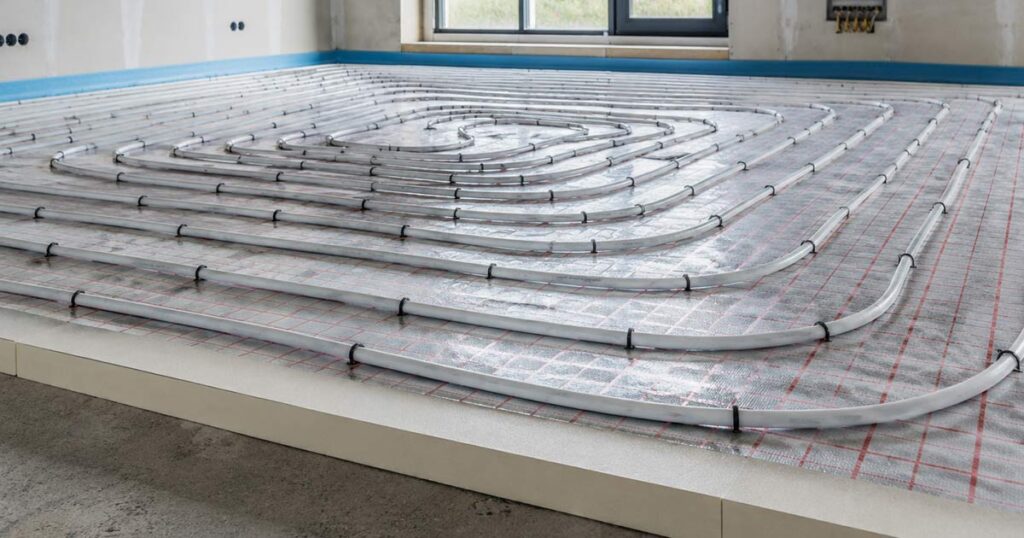
An underfloor heating system distributes heat through a network of pipes embedded in the screed, providing uniform temperatures throughout indoor spaces and a high level of thermal comfort.

For the system to operate at maximum efficiency, however, heat must be directed upwards while limiting heat loss through the floor slab. Without adequate thermal insulation, part of the energy produced can be lost towards the rooms below or the ground, reducing the overall efficiency of the heating system.

The consequences are clear: higher energy consumption, longer heating times, reduced comfort and a less efficient response from the entire radiant heating system.

Installing high-performance insulation beneath the screed helps minimise heat loss and make better use of the energy generated. The benefits affect both heating system performance and the overall energy efficiency of the building, helping to:

  • improve the efficiency of the radiant heating system;
  • increase indoor thermal comfort;
  • reduce energy consumption;
  • limit thermal bridges;
  • improve building sustainability.

How Underfloor Heating Works

The operating principle is simple: warm water, generally at a low temperature, circulates through pipes embedded in the screed, gradually transferring heat to the floor surface. From there, heat is radiated evenly into the room, reducing the strong temperature stratification typically associated with conventional radiator systems.

Because it operates at relatively low temperatures, underfloor heating is particularly suitable for use with modern high-efficiency systems such as heat pumps, hybrid systems, mechanical ventilation systems (MVHR), solar thermal collectors and condensing boilers.

POLIISO® AD and POLIISO® EXTRA: PIR Panels for Radiant Floor Insulation

For the insulation of radiant floors, Ediltec Insulation has developed two specific solutions: POLIISO® AD and POLIISO® EXTRA. Both consist of rigid closed-cell polyiso PIR foam and are designed to improve the energy performance of the heating system, limit heat loss and provide a stable, durable floor build-up.

Thanks to their high thermal insulation performance, these panels make it possible to reduce construction thicknesses without compromising performance, while contributing to vapour control and the overall energy efficiency of the building.

POLIISO® AD: PIR Panel with Embossed Aluminium Facing

POLIISO® AD consists of rigid closed-cell polyiso PIR foam faced on both sides with embossed aluminium. This configuration is designed for applications requiring high thermal performance, effective vapour control and maximum efficiency of the radiant heating system.

The aluminium facing also contributes to the overall performance of the system by interacting with the infrared radiation generated within the floor build-up. This helps optimise heat distribution within the system, contributing to improved heating efficiency and reduced energy consumption.

POLIISO® EXTRA: A Versatile Solution for Floors and Slabs

POLIISO® EXTRA consists of rigid closed-cell polyiso PIR foam between two multilayer aluminium facings. It is a particularly versatile solution, suitable not only for radiant floors but also for a wide range of roof and floor slab applications.

The combination of the insulating core and multilayer facings provides high dimensional stability, excellent thermal performance, good mechanical resistance and long-term durability of the overall build-up.

Thermal Conductivity λD 0.022 W/mK

One of the main advantages of POLIISO® panels is their high thermal insulation performance. Both POLIISO® AD and POLIISO® EXTRA have a declared thermal conductivity λD of 0.022 W/mK, allowing high thermal performance to be achieved with reduced insulation thicknesses.

This provides several design and installation advantages:

  • reduced heat loss;
  • improved radiant floor efficiency;
  • lower energy consumption;
  • optimisation of floor build-up thickness;
  • improved overall building energy performance.

Thin Insulation for Renovation and Refurbishment Projects

In energy renovation projects, available construction depth is often one of the main design constraints.

The use of high-performance PIR insulation panels makes it possible to:

  • reduce the thickness of the floor build-up;
  • minimise the impact on existing floor levels;
  • preserve usable internal height;
  • simplify renovation work;
  • reduce the overall weight of the floor build-up.

Vapour Barrier and Moisture Protection

The impermeable facings of the panels provide:

  • μ = ∞.

This characteristic creates a highly effective barrier to water vapour transmission, helping to:

  • prevent condensation;
  • protect the floor build-up;
  • preserve insulation performance;
  • increase the durability of the radiant floor system.

Traditional Insulation or PIR Panels: What Are the Differences?

The choice of insulation material directly affects the performance of the radiant floor and, more generally, the energy efficiency of the building.

Compared with traditional insulation materials, polyiso PIR foam panels provide higher thermal insulation performance, making it possible to achieve equivalent thermal performance with reduced thicknesses while improving vapour control and insulation continuity.

Characteristic Traditional Insulation POLIISO® PIR
Thermal performance Medium Very high
Required thickness Higher Reduced
Energy efficiency Standard High
Vapour control Limited Excellent
Compatibility with radiant floors Good Optimised
Thermal bridge reduction Medium High

The high insulating performance of PIR provides a tangible advantage both during the design phase, by reducing the overall thickness of the floor build-up, and during operation, by helping to reduce energy consumption and improve indoor comfort.

How to Install the Insulation Panels

Correct installation of the insulation panels is essential to ensure the proper operation of the radiant heating system. A correctly designed and installed floor build-up helps minimise heat loss and maintain maximum system efficiency over time.

In general, installation involves the following steps:

  1. preparation and cleaning of the floor slab;
  2. installation of any required waterproofing layer;
  3. dry installation of the insulation panels;
  4. careful positioning of the panels to ensure continuous insulation;
  5. installation of the separation layer;
  6. installation of the radiant heating pipes;
  7. application of the screed;
  8. installation of the final floor finish.

Correct installation of the complete floor build-up helps preserve insulation performance over time and ensures maximum efficiency of the heating system.

Indoor Comfort and Reduced Energy Consumption

Floor insulation not only improves the building’s energy efficiency but also directly affects everyday indoor comfort. By limiting downward heat loss, heat can be distributed more effectively, allowing the radiant system to reach the required temperature more quickly and maintain it with lower energy consumption.

The main benefits include:

  • improved thermal comfort throughout the building;
  • more uniform and stable indoor temperatures;
  • reduced energy consumption;
  • increased efficiency of the radiant heating system;
  • improved performance of heat pumps and low-temperature heating systems;
  • greater indoor comfort and improved building sustainability.

Conclusions

Thermal insulation beneath radiant heating systems is a strategic element in the design of energy-efficient buildings.

With POLIISO® AD and POLIISO® EXTRA PIR panels, Ediltec Insulation S.p.A. provides advanced solutions combining:

  • high thermal insulation performance;
  • thermal conductivity λD of 0.022 W/mK;
  • vapour barrier performance;
  • reduced construction thicknesses;
  • improved indoor thermal comfort;
  • optimisation of underfloor heating system performance.

As the construction industry increasingly focuses on energy efficiency and indoor comfort, the use of high-performance PIR insulation panels beneath radiant floors represents an effective solution for improving the energy performance of modern buildings.

Newsletter

I do accept the privacy policy conditions and I do accept to receive commercial newsletter on Ediltec products.
Discover more

Related insights

Sembra che quello che stai cercando non ci sia.
This site is registered on wpml.org as a development site. Switch to a production site key to remove this banner.