

Detail
Flat roofs
  • Inverted roof
  • Hot roof
Sloped roofs
  • Sloped roofs with ventilated gap below membrane
  • Insulation of sloped roofs on wood beams
  • Sloped roofs with ventilated gap over membrane
  • Microventilated roofs
Cavity walls insulation
  • Cavity walls
Exterior insulation
  • Ventilated walls
  • External insulation
Interior insulation
  • Interior
Walls below ground
  • Walls below ground
Residential floors
  • Floors
Industrial floors
  • Cold storage rooms floors
Thermal bridges
  • Insulation of thermal bridges
Isothermal trucks
  • Isothermal trucks
Infills and renovations in humid rooms
  • Infills and renovations in humid rooms
Sandwich panel
  • Sandwich panel

Why Polyurethane?

Building Envelope

Why Polyurethane?

PIR-poliuretane-poliiso-insulation-panel

Why choose a PIR insulation board? The characteristics that make the difference

When it comes to thermal insulation, the choice of material has a direct impact on a building’s energy performance, indoor comfort and the long-term durability of the entire construction system. Not all insulation materials deliver the same performance at the same thickness or under the same application conditions.

The video on this page explains some of the key principles behind the choice of polyiso (PIR) insulation boards, highlighting the characteristics that have made this technology a benchmark for high-performance thermal insulation.

Insulation means investing in the future of the building

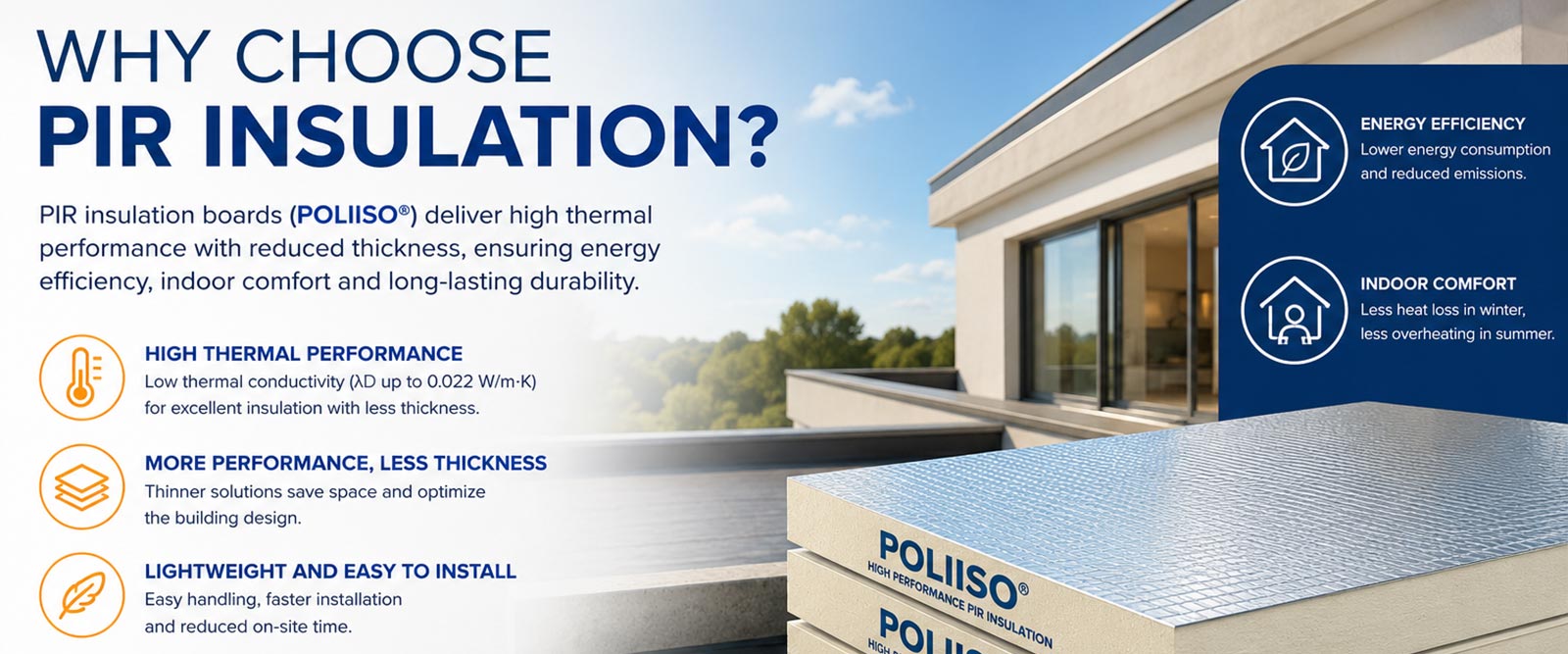
Thermal insulation is designed to limit heat loss during winter and reduce overheating during summer. This translates into lower energy consumption, improved indoor comfort and reduced emissions associated with heating and cooling buildings. A well-designed building envelope also helps meet increasingly demanding energy-efficiency requirements and represents a long-term investment in the performance and value of the building.

Video: The benefits of POLIISO polyurethane insulation

Polyurethane Foam – Ediltec Thermal Insulation – Why POLIISO?

Among the insulation materials available today, PIR (polyisocyanurate) stands out for its high thermal resistance, making it possible to achieve excellent insulation performance with reduced thicknesses. This is particularly important in both new construction and renovation projects, where available space can be a significant design constraint. The technological development of Ediltec insulation boards has also led to declared thermal conductivity (λD) values as low as 0.022 W/m·K, enabling high levels of energy performance with increasingly efficient insulation solutions.

More performance, less thickness

One of the main advantages of PIR insulation boards is their excellent relationship between thermal performance and thickness. For the same required level of thermal resistance, thinner insulation solutions can be used compared with materials with higher thermal conductivity, helping to preserve usable space and optimise the overall build-up. The low weight of PIR boards also facilitates handling on site and can make installation faster and more efficient.

One material, multiple applications

The performance of an insulation board does not depend solely on its insulating foam core. The type of facing also plays an important role and can be selected according to the intended application.

Ediltec offers different facing solutions designed to meet the requirements of roofs, walls, floors and other specialised applications while maintaining high thermal and mechanical performance.

This versatility makes it possible to identify the most appropriate solution for each project without compromising energy efficiency.

Performance designed to last

Choosing an insulation system is not simply a matter of considering its initial thermal conductivity value. Its ability to maintain the required performance throughout the service life of the building is equally important.

For this reason, the insulation system should always be evaluated as a whole, taking into account material quality, appropriate design and correct installation.

The video explores these principles, providing a clear overview of the characteristics that make PIR one of the leading technologies for high-performance thermal insulation of the building envelope.

Newsletter

I do accept the privacy policy conditions and I do accept to receive commercial newsletter on Ediltec products.
Discover more

Related articles

Expanded Polyurethane

POLIISO® TEGOLA

Under-tile roof insulation Insulating a pitched roof requires a solution capable of combining high thermal performance, ease of installation and long-term reliability. This is why…
DOPPIO PASSO

POLIISO® TEGOLA DOPPIO PASSO: A More Practical Format for Roof Insulation

The new 1,190 mm format designed to make installation easier In roof insulation, innovation is not only about thermal performance. Design details can make a…
Building Envelope

How to Improve Summer Thermal Comfort in Buildings

In modern thermal insulation, summer thermal comfort has become one of the most important aspects of building envelope design.
This site is registered on wpml.org as a development site. Switch to a production site key to remove this banner.